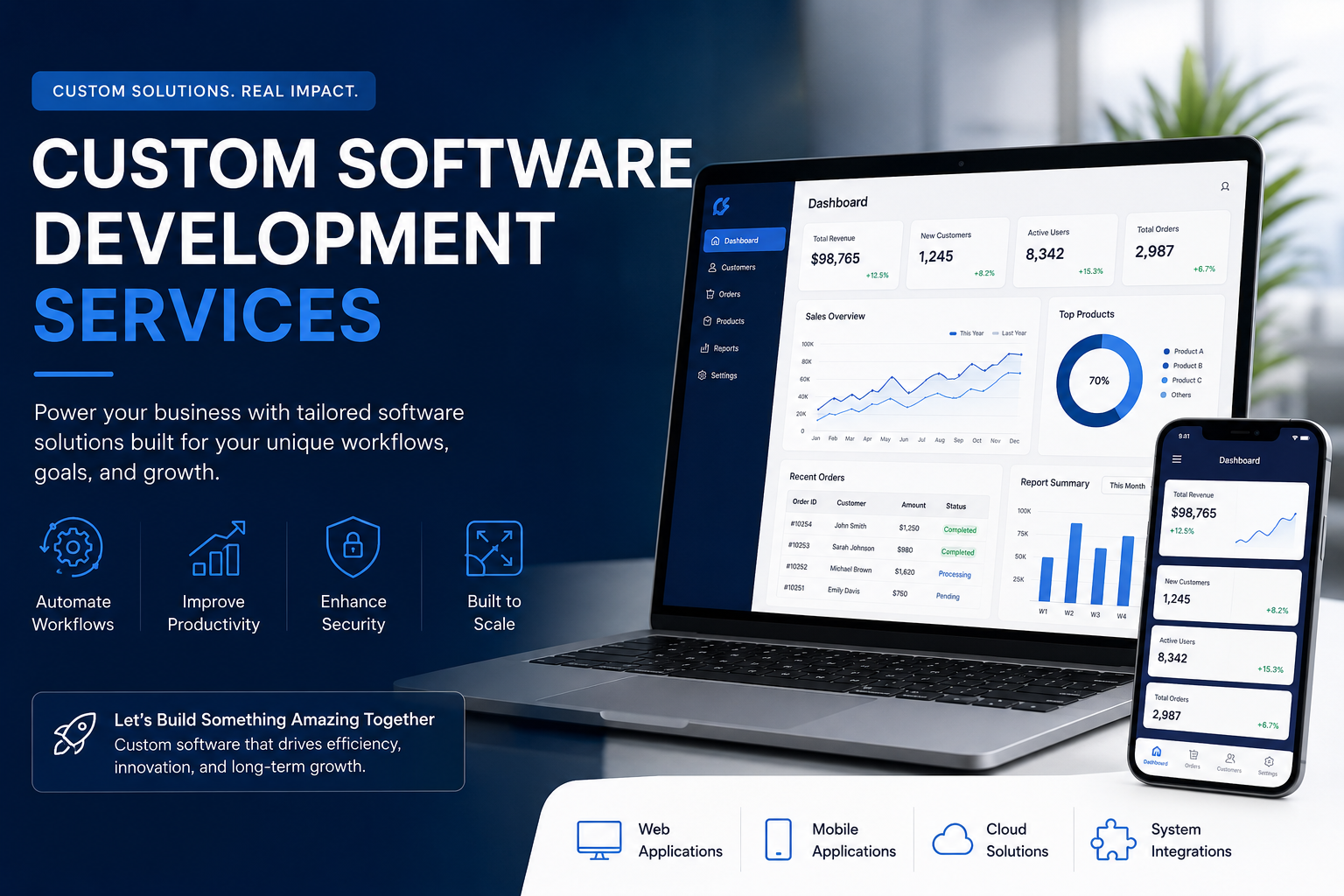
Every business reaches a point where spreadsheets, disconnected applications, and generic software begin slowing growth instead of enabling it. Whether you’re managing customers, inventory, operations, finance, or internal workflows, off-the-shelf software often forces businesses to adapt their processes to fit the software—not the other way around.
Custom software development changes that equation.
Instead of compromising your business operations, custom software is designed specifically around your workflows, business goals, customers, and future growth plans.
In this guide, you’ll learn what custom software development is, who needs it, how the development process works, how much it typically costs, and what to look for when choosing a software development partner.
What Is Custom Software Development?
Custom software development is the process of designing, building, deploying, and maintaining software tailored specifically to the requirements of a business or organization.
Unlike ready-made software that serves a broad audience, custom software is built to solve unique business challenges.
Examples include:
- Customer Relationship Management (CRM) systems
- Enterprise Resource Planning (ERP) platforms
- Inventory Management Systems
- Warehouse Management Software
- Healthcare Management Platforms
- Learning Management Systems
- Booking Platforms
- Logistics Management Systems
- Manufacturing Software
- Vendor Portals
- Customer Portals
- Mobile Applications
- SaaS Platforms
Every feature is developed based on your business requirements rather than unnecessary functionality included in generic products.
Why Businesses Choose Custom Software
Businesses invest in custom software because it provides long-term operational advantages.
Some of the biggest benefits include:
- Increased productivity
- Automation of repetitive tasks
- Better customer experience
- Improved reporting and analytics
- Integration with existing systems
- Enhanced security
- Scalability as the business grows
- Lower long-term operational costs
Instead of paying for multiple disconnected subscriptions, organizations can centralize operations within a single platform.
Signs Your Business Needs Custom Software
Many companies continue using spreadsheets and multiple SaaS products long after they’ve outgrown them.
You may benefit from custom software if:
- Employees manually copy data between systems
- Teams rely heavily on Excel spreadsheets
- Existing software cannot meet your workflow requirements
- Multiple software subscriptions are increasing costs
- Reporting requires manual effort
- Customers experience delays due to inefficient processes
- Your business requires integrations unavailable in existing software
- Data is scattered across different applications
These are clear indicators that customized software can improve operational efficiency.
Types of Custom Software Solutions
Custom software can be developed for virtually any business function.
Common solutions include:
Customer Relationship Management (CRM)
Manage leads, customers, quotations, sales pipelines, support tickets, and follow-ups in one centralized platform.
Enterprise Resource Planning (ERP)
Integrate finance, HR, inventory, procurement, manufacturing, and operations into a unified system.
Mobile Applications
Native and cross-platform mobile applications for Android and iOS with seamless backend integration.
Customer Portals
Provide customers with secure access to orders, invoices, reports, documents, and support requests.
Inventory Management
Track stock levels, warehouses, suppliers, purchase orders, and product movement in real time.
Workflow Automation
Automate approvals, notifications, document generation, invoicing, and repetitive business processes.
Custom Software Development Process
A successful software project follows a structured development lifecycle.
1. Discovery
Business goals, challenges, user requirements, and project scope are identified.
2. Planning
Technical architecture, timelines, milestones, and technology stack are finalized.
3. UI/UX Design
Interactive wireframes and user-friendly interfaces are designed before development begins.
4. Development
Frontend, backend, APIs, databases, and integrations are built using modern development practices.
5. Quality Assurance
Every feature is tested for functionality, security, performance, and compatibility.
6. Deployment
The application is deployed to cloud infrastructure or on-premise servers.
7. Ongoing Support
Continuous improvements, monitoring, updates, and maintenance ensure long-term reliability.
How Much Does Custom Software Development Cost?
The cost depends on several factors, including project complexity, integrations, number of users, security requirements, and desired features.
Typical ranges include:
| Project Type | Estimated Timeline |
|---|---|
| MVP | 2–3 Months |
| Business Portal | 3–6 Months |
| CRM Platform | 4–8 Months |
| ERP System | 6–12 Months |
| Enterprise Platform | 9–18 Months |
Rather than focusing only on development cost, businesses should evaluate the long-term return on investment through improved efficiency, reduced manual work, and increased productivity.
How to Choose the Right Software Development Company
Selecting the right development partner can significantly influence project success.
Consider the following:
- Experience with similar projects
- Transparent development process
- Strong communication
- Scalable architecture
- Security best practices
- Cloud deployment expertise
- Post-launch support
- Clear project documentation
A reliable software partner should understand your business objectives—not just your technical requirements.
Frequently Asked Questions
Is custom software better than off-the-shelf software?
Custom software is ideal when your business processes are unique or when existing software cannot efficiently support your operations.
How long does custom software development take?
Depending on complexity, projects typically range from two months to over a year.
Can custom software integrate with existing systems?
Yes. Modern software can integrate with payment gateways, CRMs, ERPs, accounting platforms, cloud services, and third-party APIs.
Can mobile apps be developed alongside web applications?
Yes. Many businesses build web platforms and mobile applications simultaneously to provide a seamless experience across devices.
Conclusion
Custom software is more than a technology investment—it’s a strategic business asset. By aligning software with your unique processes, you can streamline operations, improve customer experiences, reduce inefficiencies, and create a platform that scales with your business.
Whether you’re planning a custom CRM, ERP, customer portal, SaaS platform, or mobile application, investing in the right development approach today can deliver measurable value for years to come.
Ready to Build Custom Software for Your Business?
If you’re looking to develop a secure, scalable, and high-performance software solution tailored to your business goals, our team can help. We specialize in custom software development, web applications, mobile app development, API integrations, cloud-native solutions, and business automation platforms.
Contact us today for a free consultation and discover how custom software can accelerate your business growth.